product_detail
Broken graphite rods stop furnace power transmission, contaminate molten metal and create safety hazards. Most failures are not random; they come from material mismatch, poor machining, improper installation and wrong operating rules. Jiecheng Graphite sorts the most common failure modes for graphite rod users in thermal processing and foundry industries.
Thermal Shock Cracking
This is the most frequent failure. Graphite has low thermal expansion, but rapid uneven heating creates internal stress. Cold graphite rods loaded directly into hot furnaces, or local hot spots from uneven current, produce longitudinal cracks. Rods stored in humid warehouses absorb water; trapped steam expands sharply at high temperature and splits the rod body. Always store graphite rods in dry areas and follow slow heating curves for new assemblies.
Bending Deformation Under Load
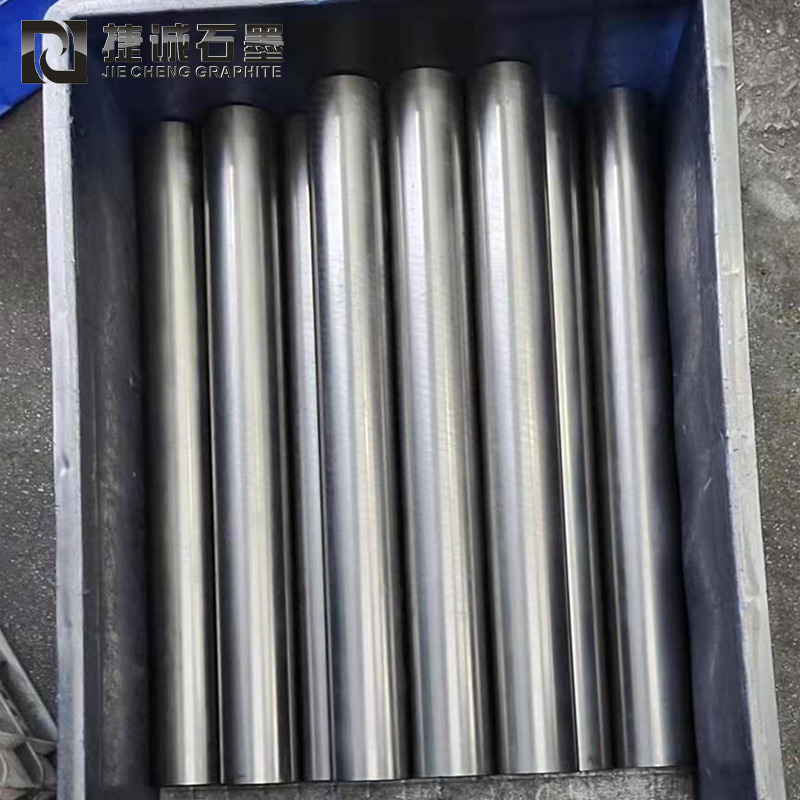
Graphite is brittle and has limited creep resistance at ultra-high temperature. Long, thin graphite rods under heavy suspended load will bend gradually over cycles. The risk rises when working temperature exceeds 1800°C. The solution is to increase rod diameter, add intermediate supports, or switch to higher flexural strength isostatic graphite. Avoid over-length cantilever designs for stirring shafts and furnace connecting rods.
Oxidation Thinning and Section Loss
Graphite oxidizes continuously above 600°C in open air. The outer diameter shrinks slowly, and the rod becomes weaker until fracture. Rods running in air atmosphere can adopt anti-oxidation impregnation treatment. Vacuum or inert gas environments greatly reduce oxidation consumption. Regularly measure rod diameter to schedule replacement before failure.
Thread and Machined Feature Failure
Threaded ends, shoulder steps and pin holes are stress concentration points. Rough machining, sharp corners and insufficient thread depth cause cracks starting from these positions. Threads on graphite rods cannot bear heavy impact or frequent tightening. Use soft carbon gaskets for connection, and avoid hard metal wrenches applying excessive torque.
Corrosion and Slag Infiltration
Graphite stirring rods for aluminum, copper alloy contact molten slag constantly. Slag penetrates open pores, solidifies and expands, peeling the graphite surface and causing spalling. High-density low-porosity graphite plus anti-infiltration impregnation is the standard solution. Clean slag residue after each melting cycle.
Quick Troubleshooting Reference
- Longitudinal cracks after heat-up: moisture absorption or too fast temperature rise
- Rod bends slowly at high temperature: insufficient strength or excessive span
- Diameter reduces steadily: oxidation in air environment
- Crack starts at threads or shoulder: machining stress or over-torque
- Surface peeling and pitting: slag and melt infiltration
Practical Operation Rules
Heat up new graphite rods gradually.
Reduce cantilever length for stirring and hanging rods.
Protect exposed rods with inert gas or anti-oxidation treatment.
Use matched carbon gaskets for threaded connections.
Select high-density grades for direct contact with molten alloy.
Jiecheng Graphite marks material limits and torque suggestions on custom machined graphite rods. Our engineering team can provide assembly guidance to reduce unexpected breakage and extend service life.